IANS | 24 Dec, 2025
The year 2025 has emerged as a testing phase for India-United States relations, marked by sharp trade frictions and renewed US engagement with Pakistan, even as the two strategic partners made quiet but consequential progress in defence, technology and energy cooperation, a leading India-US policy expert has said.
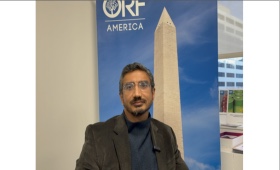
“2025 has been a testing year for India-US relations,” Dhruva Jaishankar, executive director of the Observer Research Foundation America, told IANS in an interview, pointing to what he described as the two most significant challenges confronting the relationship.
“The two biggest challenges… have been tariffs, which continue very high, 50 per cent tariffs on India, which are amongst the highest that the US is applying anywhere and is putting Indian exporters at a disadvantage,” he said. The second, Jaishankar added, was “a slight restart and particularly high level engagement of US-Pakistan relations between Pakistan military leadership.”
He said these developments had led to “some erosion of trust between the US and India,” even though the relationship began the year on what he described as a “very promising note.”
At the same time, Jaishankar underscored that 2025 had also been “paradoxically a very good year for US-India relations in some other ways,” with important breakthroughs that have received less public attention.
“We had some breakthroughs on defence,” he said, citing the new US-India defence framework, expanded military exercises involving all three services, and continued defence sales. He also pointed to what he described as “a landmark year for AI investment from the US to India,” along with progress on space cooperation and energy ties, including “a major deal” on liquefied petroleum gas.
“So a mixed picture,” Jaishankar said. “The headlines have been negative with good reason… but beneath that surface, I think there’s actually been some quite productive progress in certain areas.”
Trade, however, remains the most visible and politically sensitive fault line. Jaishankar said India had begun negotiations “very early with the Trump administration in February, March,” and that expectations were high the deal would be wrapped up by April following Vice President JD Vance’s visit to India.
“The terms of reference were signed between the US and India, so it was quite in an advanced state already,” he said.
He attributed the delay to differences over operational issues and the linkage of unrelated concerns to trade talks. “Other issues such as India’s purchases of Russian oil got tied up in the trade negotiations,” he said, adding that the deal is “within reach” but constrained by “the politics of it rather than the economics of it.”
Jaishankar noted that India, meanwhile, has concluded trade agreements with the UK, Oman and New Zealand, restarted talks with Canada, and made progress with the European Union and Israel. “The offer remains on the table, but there’s understandably a growing sense of frustration in New Delhi,” he said.
Despite punitive tariffs, bilateral trade flows have continued to grow unevenly. Dhruva Jaishankar said Indian exports to the US rose “almost 25 per cent” in the first eight months of 2025, while US exports to India increased by only three per cent.
“So it doesn’t seem that President Trump’s objective of balancing trade between the US and India is being met,” he said, adding that while certain sectors and firms have been hit, “overall it hasn’t had as much of an impact as many feared.”
In the final months of 2025, Prime Minister Narendra Modi and President Donald Trump spoke “at least four times,” and cabinet-level engagement resumed after a pause, suggesting efforts on both sides to stabilise ties, he said.
“There has been a resumption… of cabinet-level contacts and meetings between the two sides,” he said, pointing to “some fruitful agreements on defence, on energy.”
However, the parallel revival of US-Pakistan engagement has unsettled New Delhi. Jaishankar described the relationship as “still substantively quite thin,” stressing that there has been no resumption of major US defence sales to Pakistan and that bilateral trade remains modest.
“But there are two ways of looking at the Pakistan relationship,” he said. One is military-to-military engagement, with Pakistan making itself “useful for certain contingencies for the US and the Middle East,” including Afghanistan, Iran, Gaza and the security of Saudi Arabia.
“The second aspect,” he added, involves Pakistan offering economic opportunities, particularly in “critical minerals, cryptocurrency and certain other areas.” While this has led to some US lending and offtake arrangements, Jaishankar emphasised that it remains “quite modest compared to what the US-India economic relationship” represents.
India and the US have built a multifaceted partnership over the past two decades, spanning defence, technology, education and people-to-people ties. Despite periodic turbulence, both governments have repeatedly described the relationship as one of the most consequential of the 21st century.
Washington and New Delhi continue to share converging interests in the Indo-Pacific, even as trade disputes and regional geopolitics test the durability of their strategic alignment.