IANS | 01 Feb, 2026
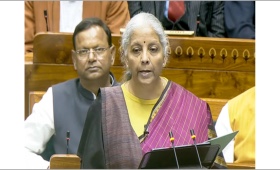
In her budget presentation, Finance Minister Nirmala Sitharaman outlined measures to keep India's economic engine running strongly despite global uncertainties, with the Narendra Modi government committing fresh resources to manufacturing expansion, semiconductor development, infrastructure upgrades, and incentives for data centre growth.
The Finance Minister proposed raising capital expenditure by 9 per cent to reach Rs 12.2 lakh crore in 2026-27, marking one of the largest such allocations in recent times and equating to 4.4 per cent of GDP.
“In 2026-27, I propose to increase public capex to Rs 12.2 lakh crores,” Sitharaman declared, explaining that the step aims to fuel infrastructure-driven expansion capable of maintaining annual growth above 7 per cent. The figure represents a dramatic rise from the Rs 2 lakh crore level recorded in 2014-15.
Among the biggest increases, defence secured Rs 7.85 lakh crore overall, of which Rs 2.31 lakh crore goes towards capital spending—a jump of 21.84 per cent intended to modernise equipment, strengthen aircraft and naval capabilities, and advance self-reliance under the “Aatmanirbhar Bharat” initiative amid ongoing border challenges.
The outlay for the Electronics Components Manufacturing Scheme doubled to Rs 40,000 crore to build on current investment trends. The Biopharma SHAKTI programme was allotted Rs 10,000 crore spread over five years to help establish India as a leading global biopharmaceutical centre.
Another Rs 20,000 crore over the same period was earmarked for Carbon Capture, Utilization and Storage technologies to support cleaner industrial processes. A fresh Rs 10,000 crore initiative targets container manufacturing to foster a more competitive logistics environment.
Railways will see capital spending of Rs 2.77 lakh crore, including plans for seven high-speed passenger corridors.
The Ministry of Home Affairs received Rs 2.55 lakh crore to bolster internal security and law enforcement.
States are assured Rs 1.4 lakh crore through Finance Commission grants while continuing to enjoy 41 per cent of tax devolution.
The Finance Ministry received the single largest share at Rs 19.72 lakh crore, primarily to meet interest obligations, subsidies, and transfers to states. Strategic and manufacturing sectors saw notable uplifts.
Sitharaman announced backing for mineral-rich states, stating, “We now propose to support the mineral-rich states of Odisha, Kerala, Andhra Pradesh, and Tamil Nadu in establishing dedicated rare-earth corridors.” Micro, small and medium enterprises benefit from a new Rs 10,000 crore SME Growth Fund, plus an additional Rs 4,000 crore infusion into the Self-Reliant India Fund.
“The allocations reflect the government’s sankalp to prioritise the poor, underprivileged and disadvantaged, while sustaining economic momentum,” the Finance Minister remarked.
She identified six priority growth drivers: expanding manufacturing scale, revitalising traditional industries, empowering MSMEs, accelerating infrastructure, ensuring energy security, and developing city-based economic zones.
The proposals align closely with the long-term Viksit Bharat 2047 vision, placing emphasis on employment generation, skill development, and building safeguards against external shocks.
The total budgeted expenditure stands at Rs 53.47 lakh crore, with the fiscal deficit targeted at 4.3 per cent of GDP, an improvement from the 4.4 per cent revised estimate for 2025-26. This reflects continued fiscal discipline while supporting accelerated progress.
Prime Minister Narendra Modi’s goal of achieving developed-nation status by 2047 demands sustained 7–8 per cent annual growth, a trajectory backed by the latest Economic Survey’s 7.4 per cent forecast for the current year and the IMF’s projections of 7.3 per cent in 2025 and 6.4 per cent in 2026.
Debt-to-GDP is set to ease from 56.1 per cent to 55.6 per cent next year, with a longer-term aim of around 50 per cent within five years.