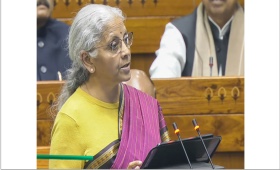
IANS | 01 Feb, 2026
The Union Budget 2026–27 presented by Finance Minister Nirmala Sitharaman marks a decisive step in reshaping India’s tax and trade landscape. With reforms spanning customs, indirect taxation, direct tax rationalisation, and incentives for cooperatives and the IT sector, the proposals aim to simplify compliance, reduce burdens, and strengthen competitiveness.
Customs processes are being modernised through digitalisation and AI, while exporters and industries gain relief via duty exemptions and extended timelines. Individuals benefit from reduced tariffs, medical duty waivers, and easier dispute resolution.
Together, these measures reflect a balanced approach—supporting growth, encouraging innovation, and making taxation more citizen-friendly.
Indirect Tax – Customs & Process Reforms
* Minimal intervention in customs processes for smoother and faster movement of goods
* Duty deferral period for Tier 2 and Tier 3 Authorised Economic Operators (AEOs) extended from 15 days to 30 days
* Validity of advance rulings binding on Customs increased from 3 years to 5 years
* Government agencies encouraged to leverage AEO accreditation for preferential cargo clearance
* Regular importers with trusted supply chains to be recognised in risk systems, reducing verification requirements
* Import of goods not requiring compliance allowed via electronic bill of entry filing with automatic Customs notification
* Warehousing framework transformed into operator-centric self-declaration, electronic tracking, and risk-based audits
* Cargo clearance approvals to be processed through a single interconnected digital window by end of FY2026
* Clearance processes for food, drugs, plant, animal, and wildlife products to be operationalised by April 2026 • Customs Integrated System (CIS) to be rolled out within 2 years as a scalable platform for all customs processes
* Non-intrusive scanning expanded with advanced imaging and AI technology, ensuring every container at major ports is scanned New Export Opportunities
* Fish catch by Indian vessels in EEZ or High Seas made duty-free; landing at foreign ports treated as exports
* Courier export value cap of ₹10 lakh removed, enabling small businesses, artisans, and start-ups to access global e-commerce markets
Other Indirect Tax Announcements
* Duty-free import limit for seafood processing inputs raised from 1% to 3% of previous year’s export turnover
* Duty-free imports extended to shoe uppers, beyond leather and synthetic footwear
* Export period for leather, textile, and footwear products extended from 6 months to 1 year
* Exemption of basic customs duty on capital goods for lithium-ion cell manufacturing for energy storage systems
* Exemption of basic customs duty on sodium antimonate imports for solar glass production
* Nuclear power projects exempted from basic customs duty on imports until 2035, expanded to all nuclear plants • Exemption of basic customs duty on capital goods used for processing critical minerals in India
* Biogas value excluded from Central Excise duty calculation on biogas-blended CNG
* Exemption of basic customs duty on components, parts, and raw materials for civilian, training, and defence aircraft manufacturing
* Exemption of basic customs duty on specified parts used in manufacturing microwave ovens Ease of Living
* Tariff rate on all dutiable goods imported for personal use reduced from 20% to 10%
* Basic customs duty exempted on 17 drugs and medicines for cancer patients
* Import duty exemptions extended to drugs, medicines, and FSMP for 7 additional rare diseases
* Revised baggage clearance rules for international travellers with enhanced duty-free allowances
* Honest taxpayers encouraged to settle disputes by paying additional amounts instead of penalties
Direct Tax – Key Announcements
* Interest awarded by Motor Accident Claims Tribunal exempted from income tax; TDS removed
* TCS rate on overseas tour packages reduced to 2% (from 5% and 20%) TCS rate on education and medical remittances under LRS reduced from 5% to 2%
* Manpower services brought under TDS scope, with rates at 1% or 2%
* Automated rule-based process introduced for lower/nil deduction certificates for small taxpayers
* Depositories allowed to accept Form 15G/15H and share with multiple companies on behalf of investors
* Deadline for revising returns extended to March 31 with nominal fee; filing timeline for non-audit businesses/trusts extended to August 31
* TDS on sale of immovable property by non-residents to be deposited via resident buyer’s PAN challan instead of TAN
* One-time 6-month foreign asset disclosure scheme for small taxpayers with defined categories and immunity provisions
Direct Tax – Rationalisation & Reforms
* Penalty and prosecution proceedings integrated into a single order; no interest liability during appeals
* Pre-payment requirement for reassessment cases reduced from 20% to 10%
* Taxpayers allowed to update returns even after reassessment begins, with an additional 10% tax
* Immunity framework for misreporting with 100% additional income tax
* Certain technical default penalties converted into fees
* Prosecution framework rationalised; non-production of books and TDS in kind decriminalised
* Maximum imprisonment for tax offences reduced to 2 years
* Immunity from prosecution for non-disclosure of foreign assets below ₹20 lakh, retrospectively effective from Oct 1, 2024
Cooperatives
* Deduction expanded to include supply of cattle feed and cotton seed by primary cooperative societies
* Inter-cooperative society dividend income allowed as deduction under New Tax Regime
* Exemption for 3 years on dividend income received by notified national cooperative federations on investments in companies (till Jan 31, 2026) IT Sector & Global Investment
* All software development services merged into one category – IT Services – with a safe harbour margin of 15.5%
* Safe harbour threshold for IT services raised from ₹300 crore to ₹2,000 crore
* Automated approval process for safe harbour without tax officer intervention
* Fast-tracked unilateral APA process for IT services, to conclude within 2 years (extendable by 6 months)
* Modified return facility extended to associated entities of APA participants
* Tax holiday till 2047 for foreign companies providing global cloud services via Indian data centres
* Safe harbour of 15% on cost for related entities offering data centre services from India
MAT exemption & Other Proposals
* Joint committee of MCA and CBDT to integrate ICDS into IndAS by 2027–28, ending separate accounting
* Definition of accountant under Safe Harbour Rules rationalised to support home-grown advisory firms
* Tax buyback for all shareholders treated as capital gains
* TCS rate for tendu leaf sellers reduced from 5% to 2%
* From April 2026, MAT to be treated as final tax, with rate reduced to 14% from 15%