IANS | 30 Apr, 2026
Former World Trade Organisation (WTO) Director-General Pascal Lamy has highlighted structural shifts reshaping global trade, underscoring that many of today’s trade issues extend beyond the WTO’s traditional mandate and require reform of both its rulebook and governance structures.
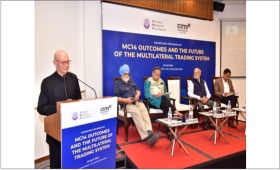
Delivering the keynote address at a high-level dialogue here, jointly organised by the Chintan Research Foundation (CRF) and CUTS International at the India International Centre (ICC), Lamy emphasised that traditional protectionism is giving way to “precautionism,” driven by rising regulatory standards and risk management concerns across countries.
He also highlighted growing macroeconomic imbalances and regulatory fragmentation as key challenges, at the roundtable, titled “MC14 Outcomes and the Future of the Multilateral Trading System”, in the national capital.
Opening the discussion, Pradeep S. Mehta, Founder Secretary General, CUTS International, described MC14 as a moment of “disappointment without disruption.”
While no major breakdown occurred, he noted that the absence of clear outcomes has intensified questions about the WTO’s relevance.
Mehta highlighted that the system has historically enabled stability, job creation, and development, particularly in developing countries, and that it must now adapt through more flexible approaches, such as variable geometry.
Chairing the session, Congress MP Dr Shashi Tharoor described the current moment as one of “quiet but consequential churn” in global trade. He noted that MC14 should not be dismissed as a failure, but rather seen as reflecting deeper structural shifts, from episodic negotiation challenges to more fundamental strains within the multilateral system.
He highlighted declining trust, geopolitical fragmentation, and the growing reliance on plurilateral approaches as defining features of the current phase.
Adding a policy perspective, eminent economist Montek Singh Ahluwalia emphasised the need for pragmatic and realistic approaches to trade policy. He noted that the WTO cannot be expected to resolve macroeconomic imbalances and stressed the importance of maintaining guardrails while aligning trade with domestic competitiveness and investment strategies.
Shishir Priyadarshi, President of CRF, underlined that while the WTO remains indispensable, especially for developing countries, its credibility has eroded over time.
He pointed to the paralysis of the dispute settlement mechanism as a major concern, warning that without enforceability, global trade risks will be shaped by power rather than rules.
While acknowledging the role of plurilateral initiatives in sustaining momentum, he cautioned against fragmentation and called for reform anchored in transparency, predictability, and fairness.
Notably, there was broad agreement that the WTO stands at a crossroads. Participants emphasised that this is less a moment of crisis and more a moment of choice, between drift and reform, and that restoring trust will be key to ensuring the system remains relevant in a rapidly evolving global economy.