It will definitely be wishful thinking to expect an export windfall with the Indian Rupee at its most undervalued status in nearly 12 years.
And when I watched Prime Minister Narendra Modi hand a packet of “Melody” toffees to Italian PM Giorgia Meloni in Rome, I couldn't help but smile at the masterclass in feel-good “Melodi” diplomacy. It is incredibly tempting to look at such sweet, globally televised optics and envision a golden era of soaring demand for Indian products abroad.
However away from the flashlights, I see our country’s export economy grappling with a far harsher reality.
By the cold arithmetic of exchange rates, I would expect our exporters to be celebrating right now. The rupee's Real Effective Exchange Rate (REER) has slid to its lowest level since 2014, moving firmly from overvalued to undervalued territory. Nominally crossing the 94-per-dollar mark recently, Indian goods are theoretically much cheaper for foreign buyers.
But that’s one side of the coin. In reality, the scenario is not that melodious. Despite this newfound currency competitiveness, our merchandise exports contracted 7.4% year-on-year in March 2026, and the trade deficit too widened to $28 billion in April. The rupee has no doubt delivered its end of the bargain, but our broader export ecosystem simply isn't ready to receive it.
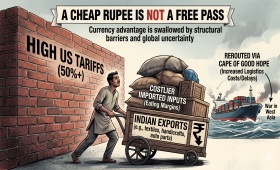
And if you ask me why I believe a cheap currency isn't working for our exporters and why this devaluation isn't translating into export success, I would say the first and foremost reason is the towering US tariff wall. With effective US tariffs on Indian goods sitting around 50%, a minor currency advantage is swallowed entirely. Without a credible India-US trade deal, and this all will agree, a cheap rupee as a purely academic advantage.
More significantly, we are structurally import-dependent. Our exporters rely heavily on imported inputs to manufacture their goods. So a weaker rupee makes those intermediates costlier, eating directly into export margins and negating any competitive gain on the final selling price.
And last but not the least is the uncertainty of the war in West Asia. Owing to the war, consignments are being rerouted around the Cape of Good Hope, raising logistics costs by up to 30% and adding weeks to transit times. For manufacturers facing costlier freight and weak global demand, a favourable currency is nothing but a cold comfort.
So in my opinion, India's export underperformance is a supply-side issue, not a currency problem. Our handicaps remain structural; be it high input tariffs on industrial materials, inefficient logistics, or a fragmented manufacturing base.
I firmly believe an undervalued rupee is an opportunity, not a strategy. However, it requires robust infrastructure, efficient supply chains, and sweeping structural reforms to actually convert into export growth. Without aggressively reducing the cost of doing business, the rupee can keep weakening, and our trade deficit will only continue to widen.