IANS | 05 Dec, 2025
India sees promising avenues for collaboration with Russia in consumer goods, food and agriculture, pharmaceuticals and medical supplies, telecom and electronics, industrial components, and the mobility of skilled talent, according to the government.
India-Russia trade has made remarkable strides, with volumes nearing $70 billion, yet immense potential remains untapped.
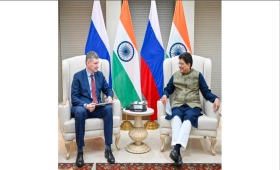
As Russian President Vladimir Putin arrived in India on a high-profile visit, Commerce and Industry Minister Piyush Goyal said at an event here that the shared focus is to foster more balanced and mutually rewarding trade, aiming to exceed $100 billion by 2030, driven by stronger Indian exports. While reaching $70 billion is a significant milestone, the current pattern of trade needs to be more balanced, he added.
The minister underlined that there is a vast range of offerings from India that can meet Russian requirements, just as there are many areas in which India can benefit from Russian strengths.
India is poised to grow from a $4 trillion economy to $30–35 trillion by 2047, when the nation celebrates 100 years of independence.
Russia has a strong demand for a wide range of industrial goods and consumer products, which creates substantial opportunities for Indian businesses.
The minister stated that several sectors already show clear potential, including automobiles, tractors, heavy commercial vehicles, electronics, smartphones, data-processing equipment, heavy machinery, industrial components, textiles and food products.
He added that these segments represent areas where India can significantly increase its presence in the Russian market.
Goyal also highlighted the strength of India’s entrepreneurial ecosystem, pointing out that India has developed the world’s third-largest startup ecosystem. The minister said that India’s young, skilled and committed workforce can help meet Russia’s projected shortfall of three million skilled professionals.
Goyal said that macroeconomic stability and strong fundamentals have been supported by transformational initiatives such as the Goods and Services Tax, simplification of compliance processes, reduction of tax rates and continuous improvement in ease of doing business. He emphasised that India produces the world’s largest number of STEM graduates — 2.4 million annually — and that their talent in areas such as design, analytics and research can significantly enhance Russia’s global competitiveness.
According to Anant Goenka, President, FICCI, the future of the India–Russia partnership lies in high-growth, high-innovation sectors: digital transformation, AI and emerging technologies, green energy, mobility and advanced manufacturing, financial innovation, and startups.