IANS | 16 Apr, 2026
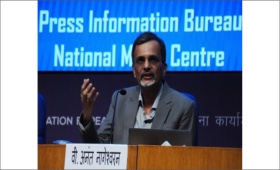
In the wake of the Iran-US war, rising crude oil prices and broader commodity pressures could complicate India’s inflation outlook and raise production costs across sectors, Chief Economic Advisor V. Anantha Nageswaran warned on Wednesday.
Speaking at the US-India Economic Forum 2026, Nageswaran said the impact of global conflict extends beyond crude prices to a wider set of critical inputs. “It is not purely about the price of oil… it is about the commodities that matter,” he said.
India’s landed cost of crude oil rose sharply in recent weeks, touching about $113 per barrel in March, with April levels still elevated near $110. He cautioned that even if markets expect a correction, prices are likely to remain significantly higher than the $60–65 range seen in recent years.
“I think an average price of somewhere closer to $90 would be more realistic,” he said, pointing to sustained pressure on the economy.
Higher energy prices feed directly into inflation and production costs. Nageswaran said India must account for rising prices not just in oil, but also in petrochemicals, fertilisers and gas—key inputs for agriculture and industry.
“Since 2025–26 was a year of benign inflation, the impact on this… will have to be factored in in terms of the macro consequences,” he said.
The spike in global commodity prices since late February has already begun to reflect in month-on-month and year-on-year increases, raising concerns over input costs for businesses and eventual consumer price pressures.
Nageswaran added that uncertainty remains high, particularly around how quickly energy markets can stabilise. “It’s one thing for the conflict to end… but another thing for restoration of normalcy in energy markets,” he said.
The risks extend to India’s fiscal and external balances, as higher import bills could widen deficits even if growth remains steady.
However, he emphasised that India enters this phase from a position of strength, with stable macroeconomic indicators and sustained growth momentum. “We are facing them with a position of macroeconomic strength,” he said.
India has maintained moderate inflation in recent years, supported by supply-side measures and improved infrastructure. The government has also stepped up monitoring of global commodity prices to respond to emerging pressures.
The challenge now will be to contain inflation without disrupting growth, as policymakers navigate a volatile global environment marked by geopolitical tensions and supply disruptions.
India, the world’s fourth-largest economy, is heavily dependent on imported energy, making it particularly vulnerable to global oil shocks. Crude oil accounts for a significant share of the country’s import bill and has a direct bearing on inflation and fiscal stability.
In recent years, the government has used a mix of tax adjustments, subsidies and supply management to cushion the impact of price spikes, while building foreign exchange reserves to manage external pressures.