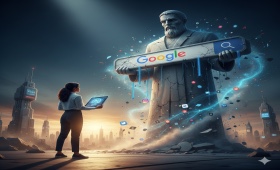
Till a few years back, this question I am sure would have been unthinkable. For over two decades, Google was the Goliath of search. It was sitting on the throne of a search built on blue links and page rank. Today things have changed drastically. Industry data suggest that Google’s global search market has dipped below 90% for the first time in over a decade. While 90% still sound like Google’s dominance in search but even a 1- 2% drop means millions of users and billions of ad-revenue migrating to other platforms.
With the advent of artificial intelligence and AI answer tools like ChatGpt, Gemini, Perplexity and more, the digital landscape is shifting completely. Things have evolved from ‘searching’ to ‘knowing the answers’. So is it too early to say that Google search is dying or that the David of Artificial intelligence has finally found the giant’s forehead?
Early in 2024, Google came with its extensive update where tens of thousands of websites were hit after their pages were de-indexed from the search engine. It was a desperate attempt by the erstwhile powerhouse to root out low value content from searches which actually turned browsers to AI tools rather than go through endless unwanted content. Definitely Google is jittery to say the least!
Cut to the chase, 4-5 years back, search engine optimisers used all the strategies to get ranked in Google and it was more like a cat and mouse game where everyone was fighting to get that coveted position on Google’s first search page. They all used to eagerly wait for Google core updates. They still do. But as the shift is happening towards getting answers, so is the strategy used by Search engine optimisers. Now the shift is more towards Generative engine optimisation (GEO) / Answer Engine Optimisation (AEO). Now the fight is not about keyword density, page-rank or link building, it is more towards building content which is worthy to appear as reference source by answer engines.
Today, SEOs are optimizing the pages with maximum information related to a product/topic which a user might search for and which can help them get the website snippet featured in the AI Overview in Google or in AI answer tools like ChatGpt, Gemini and more as the primary source. From scrolling the pages and visiting the website links, the battleground has completely changed to ‘getting the answers’ instantly without visiting the websites.
In 2026, success is not only about clicks or click through rates that we used to track through Google Analytics to measure success/ traffic on a website. We are now tracking how a website has appeared in AI responses through ‘share of model’, where a user sees the website/brand name and visits later directly. Impressions that we get in AI summary is the new metric and an important one too.
Look at Google search page today, you will see an AI overview, followed by Google ads, three four website links, followed by FAQs, Maps, People also search for, and so on. The search results have shrunk and are totally localised and intent based, which is good. But if stats that say that over 60% of searches result in zero clicks, are to be believed, we have to ask: ‘does that mean that Google is losing its grip or have already lost the numero uno position in search engines?’
Furthermore, the search is now fragmented. It is not only happening only on Google. Years ago, in my presentations about Google Ads, I used to confidently tell my sales team/ customers that ‘Google is where the user searches for anything’. Now this is no longer the truth. Today, users are everywhere and their search behaviour has changed. Depending on their intent, they might search on AI answer tools for research, browse Instagram or use specific apps for shopping, hotel booking, travel et al.. So today, there are thousands of touch points across the digital landscape.
Despite this fragmentation, there is a silver lining for all those who have experienced the changes in Google Algorithm and faced penalties in the form of rank drop in the last two decades. If you want to rank or more importantly want to show up in Google AI Overview of ChatGPT / perplexity answer, you need to follow the E-E-A-T (Experience, Expertise, Authoritativeness, and Trustworthiness) guidelines by Google. It still favours that over generic AI content and so do AI tools. The strategy is simple: be an authority on any topic/ product information that Google / AI has no choice but to show your content as the primary reference thereby getting your brand impressions, and traffic.
With the fragmentation in search, businesses have also started asking the next big question which I often get to hear in TradeIndia: “When can we run ads in ChatGpt”? “Can we show ads in Gemini”? They are eager to take that first-mover advantage and along with organic search, the shift is happening in paid ads as well.
So, who is searching on Google anyway? The answer is: everyone and no one. We are still using Google, but the fundamentals, the search behaviour and intent has changed completely. The 'David' of artificial intelligence hasn’t necessarily killed the 'Goliath' of search, but it has forced the giant to evolve and transform the way never done before.
So we must stop chasing the clicks and start claiming the answers. The Goliath is still alive but is speaking a different language now.
About the Author - Moonis Rehman is the Head of Content and Digital Marketing at TradeIndia.com. With over two decades of experience in digital marketing, Moonis has expertise in SEO, PPC, and content strategy.