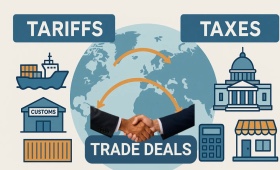
For Indian MSMEs, the year is no doubt ending on a positive note. India has recently inked trade agreements with two nations—Oman and New Zealand, coming on the heels of the UK and EFTA pacts. These agreements add another vital layer of protection to help exporters navigate the tough times caused by the additional tariffs of 50% imposed by the United States on Indian exports.
Arguably, these additional tariffs came as a blessing in disguise for the Indian exporters as they are now compelled to explore other countries and reduce their dependence on one economic superpower. The signing of these FTAs with the UK and EFTA sends a clear message that Indian businesses are resilient and are ready to face any adversity.
The trigger caused by the US tariffs also helped the government to plan, strategize and build a strong shield in the form of FTAs that will bring investments, new products and ensure that Indian MSMEs are better prepared for the global trade wars and the geo-political shifts ahead.
However, while the counter measures against the global trade war look promising, the picture on the domestic front remains grim. The well-intentioned law, section 43B(h) of the income tax act, that was brought to solve the chronic cash crunch by mandating buyers to pay within the 45 days, instead triggered a boycott from buyers. Large corporations, fearing compliance issues, canceled their orders and switched to unregistered MSMEs. This boycott forced small registered businesses to cancel their registrations in order to keep their business alive.
Recognizing that businesses are opting out of the formal system, the government in budget 2025 took corrective steps by revising the MSME classification limit and raised the investment cap for Micro enterprises to ₹2.5 crore and Small enterprises to ₹25 crore. This was a strategic move to counter the de-registrations taking place and to encourage businesses to stay registered and avail different schemes and subsidies offered - benefits of which would now be available to larger companies making the compliance worthwhile.
While the government worked to fix the regulatory environment, the financial markets also provided a necessary reality check to small businesses. It was encouraging that more and more SMES were going public with 267 SMEs coming out with an IPO this year. However, the tightening of listing norms saw reduced retail investors’ participation and average listing gains crashing to a modest 12 percent this year. This was done to ensure that public money is not treated as ‘easy money’ for small businesses and they now must have proper business fundamentals and sales figures, reinforcing the message that the stock market is a serious platform for value creation.
As the sector ushers in 2026, another challenge is already brewing for MSMEs: The Green Wall. The EU’s Carbon Border Adjustment Mechanism (CBAM) has entered its mandatory reporting phase this year, catching many engineering MSMEs off guard. The cruel irony is that while the new FTAs offer newer markets to Indian exporters they do not exempt them from carbon compliance. Both the UK and the US are considering implementing ‘carbon tax’ and the challenge will be that many Indian businesses don't have the capital for the expensive carbon audits which will be a must for selling in Europe. Thus it is not only FTA or access to markets or competitive price exporters need to be climate compliant as well to avoid punitive taxes.
Ultimately, for our businesses, the year 2025 will be remembered as the year of great resilience and pivot as they stood and survived the major US tariffs shock, weathered the domestic liquidity crisis and emerged stronger globally with the shield of trade deals. However, there will be challenges ahead in 2026. Businesses have to be climate compliant and the government needs to ensure that all the regulatory frameworks act as facilitators rather than hurdles. The trade doors are open. But the partnership between stable policy and sustainable enterprise will define India's success in the New Year.