IANS | 05 Mar, 2026
India’s housing schemes for the poor in the urban and rural areas, launched under the Pradhan Mantri Awas Yojana are setting an example for the Global South as a tool for inclusion, gender justice and empowerment of the economically weaker sections.
“In India, the push for “Housing for All” has increasingly been framed as a human rights agenda that links shelter with equality, social security and self-respect for the poorest citizens. Within this framework, the focus on women-led ownership in major housing schemes marks an important shift from seeing women as dependents to recognising them as rights holders and asset owners in their own name,” according to an article in Colombo-based Asian News Post.
Pradhan Mantri Awas Yojana in its rural and urban forms, the second phase of PMAY Urban, and the Credit Linked Subsidy Scheme together show how housing policy is being used as a tool for inclusion, gender justice and empowerment of the economically weaker sections, the article states.
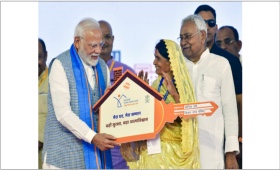
In rural India, Pradhan Mantri Awas Yojana Gramin explicitly connects the idea of a pucca house with dignity and social inclusion of the rural poor. An advisory issued under PMAY Gramin directs that women members must be included in sanction and ownership details, either as sole owners or as joint owners with male members, and even allows adding women as secondary owners where houses were initially sanctioned only in the name of men.
The results of this gender focussed approach are visible in ownership patterns. Government data indicate that nearly three out of four PMAY Gramin houses are in the name of women, and the current goal is to move towards 100 per cent women ownership under the scheme.
A house in her name strengthens a woman’s bargaining position within the family, makes it harder to displace or abandon her, and gives her a tangible asset that can be leveraged for credit, work and social status, the article points out.
Rural houses under the scheme are complemented through convergence with schemes for sanitation, drinking water, electricity, LPG and now solar power. This ensures that the beneficiary does not just receive four walls and a roof, but an integrated living environment that supports health, privacy and security, especially for women.
In urban India, Pradhan Mantri Awas Yojana Urban and its upgraded PMAY Urban 2.0 extend the same logic of inclusive housing to slum dwellers, low income workers and the aspiring middle class.
From the beginning, PMAY Urban introduced a mandatory provision that the female head of the family should be the owner or co-owner of the house in the economically weaker section and lower income group categories.
This requirement clearly signals that public subsidy for housing is conditional on recognising women’s right to property.
It also acknowledges that women in low income urban households often bear the burden of unpaid care work and are among the most affected by insecure housing, evictions and poor services, the article added.
The Credit Linked Subsidy Scheme operates as a financial lever within this ecosystem to make formal housing finance accessible to families that would otherwise be excluded.
Under CLSS, eligible beneficiaries in economically weaker, lower income and specified middle income groups receive an interest subsidy on housing loans for purchase, construction or extension of a house.
A critical condition under CLSS is that for EWS and LIG categories, women ownership is mandatory; at least one female member must be an owner or co-owner of the property. This ties the flow of concessional finance directly to women’s asset creation, encouraging families and lenders to accept women as legitimate borrowers and property holders, the article added.