IANS | 11 Nov, 2025
Highlighting the government’s efforts to make India a leader in technology, Defence Minister Rajnath Singh said on Tuesday that the country’s defence industrial base is expanding rapidly, with the synergy among DRDO, Armed Forces, industry and academia -- creating a virtuous cycle of research, testing, field feedback and innovation.
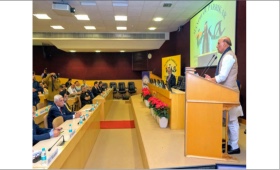
He was delivering the inaugural address at the Delhi Defence Dialogue, organised by Manohar Parrikar Institute for Defence Studies and Analyses (MP-IDSA), on the theme ‘Harnessing New Age Technology for Defence Capability Development.’
The minister said for India to move from a consumer to a creator of technology there was a need to not only acquire new innovations, but create the conditions where niche products thrive through sound processes, agile institutions, and a spirit of collaboration that unites the soldier, the scientist, the startup and the strategist.
India can no longer be content with merely catching up to global innovation, and there is a need to continue nurturing the culture of innovation, by encouraging collaboration over silos, and speed over procedural inertia.
The Defence Minister highlighted initiatives such as the Innovations for Defence Excellence (iDEX) and the Technology Development Fund (TDF) that are nurturing a new generation of innovators. “They are the architects of a future where cutting-edge technologies from autonomous systems and quantum sensors to advanced materials and space-based surveillance will bear the imprint of Indian ingenuity. From young entrepreneurs, MSMEs to captains of Indian multinationals, individuals and companies have displayed the collective will to help achieve the mission of Viksit Bharat and Aatmanirbharta,” he observed.
Rajnath Singh underscored the essentiality to extend Aatmanirbharta beyond manufacturing indigenous systems to digital sovereignty -- control over the algorithms, data, and chips that power platforms. “True strategic autonomy will come only when our code is as indigenous as our hardware. We are, therefore, encouraging secure, indigenous software stacks, trusted semiconductor supply chains, and home-grown AI models trained on Indian data.”
“Amidst all the excitement about machines and algorithms, we must remember that technology is not meant to replace human judgement, but to amplify it. We must also invest in the ethical, psychological, and legal dimensions of these emerging technologies. India, as a civilisational power, can and must lead the conversation on responsible and humane use of military technology,” the minister pointed out.
Rajnath Singh emphasised that technology must be seen not only as a force multiplier, but also as a resource optimiser. He endorsed to leverage technology and data analytics in the capital procurement process to improve decision-making and ensure optimal use of every resource. “In many advanced nations, the concept of life-cycle cost is deeply woven into their procurement frameworks. Recently, I have directed that we too must begin to assess these sustenance costs right at the inception stage of every procurement proposal. This will help us see the full picture, not only what we invest today, but what we must sustain tomorrow,” he said.
The minister urged the Armed Forces to remain on the lookout for best global practices not just in technology related to equipment, but also those related to training, logistics, planning, and management systems.
While Rajnath Singh stressed on absorbing and adapting to disruptive technologies such as Artificial Intelligence (AI), Machine Learning, Quantum Computing & Swarm Tech, he said the true test of advancement lies in how the apparatus functions.
“Harnessing technology is not just about adding new tools; it is about making our institutions more agile, anticipatory and adaptive, and creating a defence architecture that learns continuously, responds instantly and evolves relentlessly in tune with the pace of change,” he added.
Chief of Defence Staff General Anil Chauhan, Ambassadors from friendly nations as well as civil and military officials were present on the occasion.