Sneha Tiwari | 13 Mar, 2026
Today, we are into the fifteenth day of the West Asia War between Iran, the US and Israel. With mounting civilian and military casualties and no respite in sight, the world is watching with bated breath. Conflicting statements from Washington are adding to the confusion: while the US President boasts that war is in its final stages and is nearly over, his Defense Secretary warns of a long battle. Meanwhile, Iran’s supreme leadership remains defiant and is not ready to give up, promising revenge for the casualties in the country and setting strict conditions for any cessation that include compensation from the United States and Israel for destroying their infrastructure and firm international guarantees against future attacks.
With crude oil prices soaring to over $100 per barrel, the International Energy Agency (IEA) was forced to act with its member countries unblocking 400 million barrels of strategic reserves. To further ease the supply crunch, the US has also temporarily eased sanctions on buying Russian oil and has granted India a 30-day special waiver to purchase Russian crude that was previously stranded at sea.
These desperate measures clearly indicate that oil remains the bloodline of the global economy as over 80% of the world’s countries are energy deficient and depend on imports to survive. The war, if it escalates further, will severely impact the global economy with rising crude oil prices and several countries like India already witnessing a shortage of gas and the looming threat of an energy crisis. At the heart of this storm lies the Strait of Hormuz.
To understand why the global economy is on the brink, one must look at the Strait of Hormuz as the most vital geostrategic weapon in the world today.
Anatomy of the Strait of Hormuz

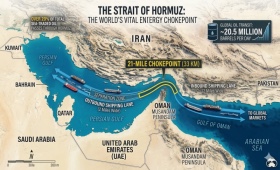
The Strait of Hormuz connects the Persian Gulf to the Gulf of Oman and the Arabian Sea. But the real issue is its size.
The Dimensions: At its narrowest point, the Strait is only 21 miles (33 km) wide.
The Shipping Lanes: For massive oil tankers, the actual safe water is even tighter. Ships have to stick to a strict Traffic Separation Scheme—basically a two-mile-wide inbound lane and a two-mile-wide outbound lane, separated by a tiny two-mile buffer zone.
The Location: Iran is in the north and Oman (Musandam Peninsula) and the UAE in the south.
Who controls the Strait of Hormuz?
While the Strait is an international waterway, its physical geography places the primary shipping lanes within Iranian and Omani territorial waters.
Role of Iran: Iran controls the entire northern coastline. The Islamic Revolutionary Guard Corps Navy (IRGC-N) maintains a heavy presence of fast-attack craft, shore-based missiles, and mine-laying capabilities.
Role of Oman: Oman controls the southern tip but generally maintains a neutral, diplomatic stance, focusing on safe passage.
The ’Jugular Vein’ in Numbers
The Strait of Hormuz is often called the ‘jugular vein’ of the global oil economy and is the world's most important energy chokepoint. In 2026, approximately 20.5 million barrels of oil per day (bpd) typically pass through the Strait. This accounts for roughly 20% of global petroleum consumption. As of today, the oil supply is completely disrupted with Iran closing down the Strait of Hormuz, issuing a clear warning that anyone who dares to pass the strait will be attacked. Beyond oil, it is also the primary route for nearly 20% of the world’s Liquefied Natural Gas (LNG), with Qatar being the primary exporter.
The Strait is also the lifeblood of Asia. Over 85% of the oil passing through Hormuz is destined for Asian markets—specifically China, India, Japan, and South Korea.
Can the World Bypass Hormuz?
The short answer is: No. While alternative pipelines exist, they cannot handle the sheer volume of the maritime route.
Combined, the existing bypass pipelines (like Saudi Arabia's East-West pipeline and the UAE's Habshan-Fujairah line) have a capacity of roughly 3.5 to 5 million bpd.
With 20 million bpd passing through Strait, even if every pipeline were running at 100% capacity, over 75% of the oil would still be trapped in the Gulf if the Strait were closed.

The Economic Fallout: 2026 Reality
As of March 2026, the crude oil prices which were at $60/barrel earlier this year, have spiked toward $120/barrel due to the conflict.
"War Risk Surcharges" have also skyrocketed with some insurance companies canceling coverage for the region entirely, forcing major shipping giants to suspend all vessels crossing through the Strait of Hormuz until further notice.
The bottom line for global trade
The current ongoing crisis is a stark reminder that the Strait of Hormuz controls the global economy to a major extent and the measures adopted by the IEA or the United States in waiving sanctions on buying Russian oil, offers only a temporary solution. For Indian MSMEs, the stakes are at an all-time high, any prolonged closure of the Strait will have a ripple effect of high freight charges, raw material delays, reduced profit margins and increased war-insurance premiums. As long as this "Jugular Vein" remains choked by the ongoing war, global economic stability hangs by a thread.
(The article was researched and compiled by Sneha Tiwari, Senior Content Writer at TradeIndia. An avid reader, Sneha writes on various topics, including business, fashion and sports.)
(All the images used are AI-Genereated)