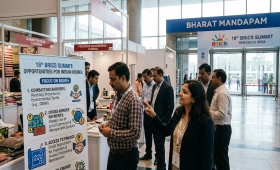
Tracking the news from the 18th BRICS summit at Bharat Mandapam, New Delhi, one question kept coming to mind: will any of the declarations adopted at the summit help Indian MSMEs? And will they remain on paper or will be implemented on ground as well?
Looking beyond the photo-ops and declarations, I see three developments that stand out for Indian MSMEs trying to survive an increasingly volatile global trade environment.
First is the growing challenge of environmental trade barriers. The BRICS New Delhi Declaration explicitly opposed unilateral, punitive, discriminatory and protectionist measures such as carbon border adjustment mechanisms. For Indian exporters in sectors such as steel, engineering and auto components, this is important. Carbon-related trade measures can add compliance costs and complexity for smaller exporters.
Second is cross-border payments and greater use of local currencies. BRICS is exploring practical solutions for more efficient cross-border payments, including interoperability of payment systems and trade settlement using member countries' local currencies. For MSMEs, simpler payment mechanisms could eventually reduce some of the friction involved in international trade. But the declaration makes clear that there is no one-size-fits-all approach, and the work is still evolving.
Third, and perhaps most important, is access to finance. BRICS has backed guiding principles for credit assessment of export-oriented MSMEs and welcomed the Jaipur Consensus to study an Invoice Discounting Mechanism. If implemented effectively, these measures could help small exporters unlock working capital and participate more easily in global value chains.
India's push for cooperation on Digital Public Infrastructure is another promising development.
For small businesses, the real test is - can BRICS make exporting easier, financing more accessible and cross-border payments more efficient? The declarations have opened the door. The ball is now in the court of the institutions, which must make sure that businesses can actually walk through it.