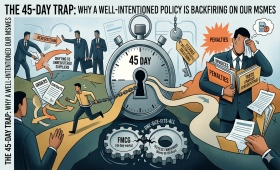
Two days from now, the world will be celebrating MSMEs day, and I am incredibly proud of our small businesses for the way they have contributed to the economy.
The government too has supported our MSME ecosystem, and we have seen several good schemes being launched over the years to help small businesses formalize and grow.
But to be honest, I am not too happy to see how some of the well thought out policies are actually playing out on the ground. The ground reality when I visit the MSMEs is totally different. For example, take the 45-day payment rule under section 43B(h) of the Income Tax Act. It mandates all the corporate buyers to make payment to the MSMEs suppliers within 45 days of the acceptance of order, failing to do so attracts heavy tax penalties.
The policy was well thought out and the idea was noble as the government wanted to solve the issue of delayed payments for MSMEs by punishing corporate buyers with tax penalties. But in my experience, and what I have seen on ground zero is that the 45-day payment rule has become more of a classic case of policy backfiring.
Sadly despite the good intentions I see a disturbing trend among MSMEs as they feel pressured to deregister their business from Udyam portal, driven by fear of losing buyers who to avoid the 45-day tax penalty are canceling their orders and are shifting their orders with unregistered suppliers. So we are wrongly penalizing our small businesses for formalizing and registering their ventures.
And there are other survival tactics as well which both MSMEs and corporate buyers employ just to keep the contracts alive, including creating multiple invoices, accepting goods at a mutually accepted later date to buy some more time for payment, and shifting to the invoicing discounting platforms like TReDS, so that on one hand, MSMEs get payment on time to pay salaries, on the other, the corporate buyers get time to make the payment beyond the mandated 45 days.
In my opinion, and I argued this before too, a one-size-fits-all- approach will not work in an economy as diverse as ours.
A 45-day payment cycle makes perfect sense for fast-moving consumer goods (FMCG) like packaged groceries. But in case of, say, textiles, where the inventory sits for months before selling or in case of heavy machinery, which takes months to build, test and install, the 45 day payment cycle is not possible. In such sectors, the natural working capital cycle is between 90 to 120 days, and forcing a 45-day payment limit, doesn't fix the cash flow, it breaks the supply chain.
The government needs to rethink this policy, and introduce a more flexible, sector-specific payment timeline that aligns with how different industries operate, accounting for their distinct sales cycles and operational demands.
Until then, what I believe is that such policies are actually a bottleneck for growth. Though they are intended to protect the working capital for MSMEs, in reality it is actually making it difficult for our small businesses to retain their buyers.