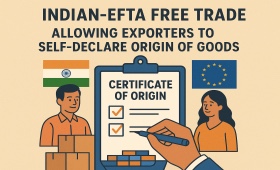
The recent government’s decision to allow exporters to self-declare origin of goods (certificate of origin or CoO) under the India-EFTA free trade is a significant and genuinely progressive step towards “ease of doing business” for Indian exporters.
With this in place, the Indian exporters will now be spared from the hassles of collecting documents, applying for the certificate, and then endlessly waiting for the approval from the authorities before shipping their goods. The move will thus not only save time, effort, and money of our exporters, thus signalling a trust in the export fraternity.
Moreover, the move reflects a broader shift in our trade policy, which is now aimed at reducing compliance and building a trust-based facilitation model that empowers the exporters.
Now with the new provisions in place, the Certificate of Origin will enable exporters to claim tariff benefits that are available in the FTA signed with an association or union. However, it is crucial that declarations made by the exporters are accurate and that they comply with the rules of origin prescribed in an agreement. Any false information will lead to penalties and will weaken our credibility in global trade. So we must take that in note.
Now back to the Indian-EFTA agreement. With the agreement in place, our exporters will now not only have broader access to key European markets like Norway and Switzerland, but will also benefit from a conducive environment for trade and investment.
Everyone will agree with me that steps like these may be small, but are significant as they are not only procedural changes. They are in actual fact crucial to build trust among our export community and empower them at the global level. These measures can go a long way in enhancing our nation’s competitiveness in global value chains.
In my opinion, this pivotal step of self-declaration of origin of goods under the EFTA will pave the way for similar provisions under other Free Trade Agreements (FTAs) as well, thus marking a new dawn built on trust that will enable seamless trade facilitation for Indian businesses.