Prime minister Narendra Modi's recent statement that MSMEs are the backbone of the country's economy couldn't have come at a better time. With the US levying more tariffs on products from India from April 2, the PM's statement, if followed by concrete steps to cushion the aftermath of Trump's "dumb" tariffs as termed by Canadian Prime Minister Justin Trudeau, would give some much-needed respite to our anxious MSMEs.
No arguing with the fact that the Jan Vishwas Act, wherein over 40,000 compliances were eliminated at both central and state levels, promoting ease of doing business, deserves an applause. However I feel there is still room for improvement.
Hopefully the Jan Vishwas 2.0 Bill which the government is now working on will ease the way MSMEs do business even further. It's good to know that a committee has already been formed to review regulations in the non-financial sector to make them modern, flexible, people-friendly and trust-based.
Back to the issue of further tariffs likely to be levied by the US, there is no denying that the United States has historically been a significant market for Indian products, especially in sectors like textiles, steel, agricultural commodities, and chemicals. However, with the imposition of higher tariffs, Indian MSMEs will definitely face stiffer competition and reduced market access.
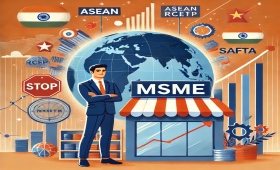
Here, MSMEs will need to focus on market diversification. We are a member of various regional trade agreements and forums like the ASEAN-India Free Trade Area (AIFTA), the Regional Comprehensive Economic Partnership (RCEP), and the South Asian Free Trade Area (SAFTA), which provide access to several growing markets across Asia, Africa, and Latin America. The need of the hour therefore, would be to strategically shift focus towards these markets. By doing so small businesses can not only tap into new sources of demand, but can also reduce dependence on the US market.
Additionally, we need to focus on expanding within the domestic market too. The country’s fast-growing middle class and the increasing demand for homegrown products can be leveraged as an alternative to international markets.
In conclusion, truth be told, if amid the ongoing global political uncertainty, the government can come up with ideas to make the country a growth engine, especially for MSMEs, it would indeed be a reason to cheer about.