|
|
|

|
'India has well-regulated and well-supervised banking sector'
|
|
|
|
| Top Stories |
 |
|
|
|
IANS | 17 Mar, 2023
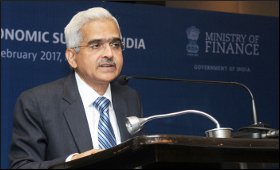
Reserve Bank of India Governor Shaktikanta Das on Friday gave a thumbs
up to the country's banking system, while stressing how recent
developments in the US have brought to the fore the criticality of
banking sector regulation and supervision.
"What we have
in India today is a well-regulated and well-supervised banking sector.
The same would apply to the NBFCs sector and other financial entities
under the RBI's domain," he said while delivering the K.P. Hormis
Commemorative Lecture here.
Hormis was the founder of the Kerala-headquartered Federal Bank.
Das
pointed out that the focus is now more on identifying the root cause of
vulnerabilities, rather than dealing with the symptoms alone.
"We
have also issued revised guidelines on oversight and assurance
functions of financial entities. Use of advanced data analytics is
supplementing our supervisory process. To strengthen cyber resilience, a
comprehensive cyber security framework for banks together with Digital
Payment Security Control Guidelines have been issued. We have also
established the college of supervisors and augmented the staff strength
significantly in recent years," he said.
Das focussed on how the
recent developments in the US banking system have brought to the fore
the criticality of banking sector regulation and supervision.
"These
are areas which have significant impact on preserving financial
stability of every country. More specifically, these developments in the
US drive home the importance of ensuring prudent asset liability
management, robust risk management, and sustainable growth in
liabilities and assets; undertaking periodic stress tests; and building
up capital buffers for any unanticipated future stress.
"They
also bring out that crypto currencies/assets or the like, can be a real
danger to banks, whether directly or indirectly," he said.
"The
Reserve Bank has taken necessary steps in all these areas. The
regulation and supervision of the financial sector and the regulated
entities have been suitably strengthened. The regulatory steps include,
among other things, the implementation of leverage ratio (June 2019),
large exposures framework (June 2019), guidelines on governance in
commercial banks (April 2021), guidelines on securitisation of standard
assets (September 2021), scale-based regulatory (SBR) framework for
NBFCs (October 2021), revised regulatory framework for microfinance
(April 2022), Revised regulatory framework (July 2022) for Urban
Cooperative Banks (UCBs) and guidelines on digital lending (September
2022)," Das added.
On India's G20 presidency, Das pointed out
that this has come at a time when the country has once again emerged as
the fastest growing major economy in the world.
"International
confidence on India's capacity to contribute constructively to reshape
the global economic order is rising. The risk of a hard landing has
dissipated world over, even as the pace of disinflation remains less
than desirable. Before the cascading effects of geo-economic
fragmentation further dampen the global outlook, rebuilding trust
through cooperation and recommitting to multilateral frameworks for
addressing critical global challenges has become essential," he said.
|
|
|
| |
|
|
|
|
|
|
|
|
|
|
|
|
|
|
| |
| Customs Exchange Rates |
| Currency |
Import |
Export |
US Dollar
|
₹96.5
|
₹94.8 |
UK Pound
|
₹132.25
|
₹128.15 |
Euro
|
₹113.6
|
₹109.8 |
| Japanese
Yen |
₹61.3 |
₹59.45 |
| As on 03 Sep, 2026 |
|
|
| Daily Poll |
 |
 |
| What’s your biggest challenge with the 45-day payment rule? |
|
|
|
|
|
| Commented Stories |
|
|
|
|
|
|
| |
|