|

|
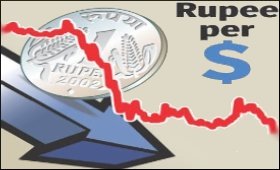
Rupee slide continues: hits new low of 54.60 against dollar
|
|
|
|
| Top Stories |
 |
|
|
|
SME Times News Bureau | 18 May, 2012
The Indian rupee fell to a new
record intra-day low for the second session in a row Thursday, despite
the Reserve Bank of India's intervention, as global as well as domestic
outlook remained grim.
The partially convertible rupee fell to a
record low of 54.60 against a dollar in the intra-day, surpassing
Wednesday's low of 54.52.
However, the Indian currency closed
marginally higher at 54.47 against a dollar -- 0.04 percent higher than
the previous day close at 54.49.
The rupee had hit a record intra-day as well as closing low Wednesday.
Analysts
said the rupee might soon touch 55 against a dollar due to grim
economic outlook and limitation of options left with the central bank to
intervene in the market.
"Rupee is driving the markets. Traders
and investors are keeping close eye on RBI action, though it seems RBI
is running out of options," said Kishor P Ostwal, chairman and managing
director of CNI Research Ltd.
He said the rupee was heading towards 55 against a dollar which would keep the Indian equity markets on edge.
Earlier
in the day, the rupee strengthened to 54.20 against a dollar taking
cues from rebound in stock markets and RBI intervention. But due to
continued risk aversion in the global markets, the rupee slipped to a
new low in the late afternoon session.
The benchmark Sensex of
the Bombay Stock Exchange closed 0.25 percent higher at 16,070.48 points
after rising to 16,240.18 points level in the intra-day.
The wide-based Nifty of the National Stock Exchange closed 0.25 percent higher at 4,870.20 points.
"The market is ignoring positive news such as drop in oil prices. If rupee slips, the market has to slip further," said Ostwal.
The Reserve Bank of India (RBI) has taken a series of measures in the last few weeks to curb the rupee slide.
The
RBI has asked banks to sell half of the foreign currencies in their
accounts. In a bid to attract money from overseas, the RBI has raised
interest ceiling that local banks can offer to overseas Indians in forex
accounts.
The RBI has opened a direct dollar window for oil
companies, which are worst hit because of the weakness in the domestic
currency as they have to pay higher money for same import.
Now
oil companies can buy dollar directly from the RBI instead of going to
commercial banks. The central bank had introduced a similar facility in
2008 also.
The RBI last week asked exporters to convert at least 50 percent of their foreign exchange holdings in rupee.
To curb the slide, the RBI is also believed to have sold dollars through public sector banks.
|
|
|
| |
|
|
|
|
|
|
|
|
|
|
|
|
|
|
| |
| Customs Exchange Rates |
| Currency |
Import |
Export |
US Dollar
|
₹94.2
|
₹92.5 |
UK Pound
|
₹128.85
|
₹124.8 |
Euro
|
₹112.2
|
₹108.45 |
| Japanese
Yen |
₹59.85 |
₹58 |
| As on 06 May, 2026 |
|
|
| Daily Poll |
 |
 |
| What is the biggest war impact on MSMEs? |
|
|
|
|
|
| Commented Stories |
|
|
|
|
|
|
| |
|