|

|
Textile mills need 10 mn new spindles: SIMA
|
|
|
|
| Top Stories |
 |
|
|
|
Namrata Kath Hazarika | 27 Jan, 2011
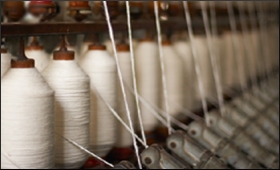
The Indian spinning and weaving sector needs to upgrade its technology by installing 8 to 10 million new spindles to covert the surplus raw cotton into value added products, said the Southern India Mills' Association (SIMA).
"There is an urgent need for upgrading the technology particularly in the weaving and processing sectors and improving scale of operation to improve value addition and achieve the target set by the government." SIMA Secretary General, K Selvaraju told SME Times recently.
While the industry needs around 8 to 10 million new spindles in the spinning to covert the surplus raw cotton into value added products, another 15 to 20 million spindles are required for replacing the obsolete technology machines, he added.
Selvaraju expects that during the next fiscal 2011-12, at least 4 million spindles would be added to the capacity if the damage control exercise is undertaken by the government immediately.
Over three lakh spindles are supplied per month by three major spinning machinery manufacturers, he said.
According to the latest statistic available of the Textile Commissioner, during November 2010, total 552 textile mills were closed amongst which 471 were spinning mills and 81 were composite mills which had an installed capacity of 9.87 million spindles, 1.0 lakh rotors, 0.37 lakh looms and
3.06 lakh workers.
According to the office of Textile Commissioner, the spinning production has grown over 12% this year as compared to the previous year and it would soon cross 15%, Selvaraju said.
"The weaving sector has shown 7% growth and has potential to achieve 10% growth. The handloom sector is having negative growth. Due to high cost of production, the handloom production capacity would continue to decline. The knitting sector has also shown less than 2% growth," he added.
Further, he also pointed out that if the Indian spinning and weaving sector has to compete globally then the industry should continuously modernise and strengthen the weaving and processing sectors.
"It should improve its operational efficiency and adopt scientific systems to remain competitive," he said.
The spinning industry employs nearly to one million people and installed capacity of spindles in India makes for 24 percent share of the global market. A recent CRISIL research report expects investments of Rs 20,600 crore during 2009-10 to 2011-12 in textiles out of this, Rs 4,400 crore is likely to be pumped in to the spinning sector.
|
|
|
| |
|
|
|
|
|
|
|
|
|
|
|
|
|
|
| |
| Customs Exchange Rates |
| Currency |
Import |
Export |
US Dollar
|
₹94.2
|
₹92.5 |
UK Pound
|
₹128.85
|
₹124.8 |
Euro
|
₹112.2
|
₹108.45 |
| Japanese
Yen |
₹59.85 |
₹58 |
| As on 06 May, 2026 |
|
|
| Daily Poll |
 |
 |
| What is the biggest war impact on MSMEs? |
|
|
|
|
|
| Commented Stories |
|
|
|
|
|
|
| |
|