|
|
|

|
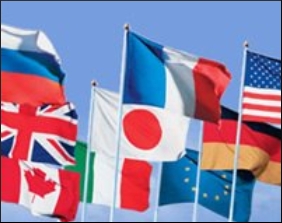
G8-G5 agree on global economic crisis, institutional reforms
|
|
|
|
| Top Stories |
 |
|
|
|
Jaideep Sarin | 10 Jul, 2009
Even as they jointly declared to conclude the Doha development round on trade talks by 2010, the world's most wealthy and industrialized countries or G8 Thursday agreed to the demands of the emerging economies (G5) to strengthen financial regulation and reform international financial and other institutions, including the United Nations (UN).
"We are committed to seek an ambitious and balanced conclusion to the Doha Development Round in 2010, consistent with its mandate, building on the progress already made, including with regard to modalities," the joint declaration said here.
"We are committed to advance reform processes in international organisations, including the UN, to reflect contemporary reality and challenges thus enhancing their relevance, legitimacy and efficiency."
The G8 countries agreed to some of the major demands made by the G5 countries on tackling the present global economic crisis.
"We have acted more forcefully and cooperated more fully than in any earlier economic crisis. We are fully committed to implementing rapidly the Washington and the London summit decisions, including those to strengthen financial regulation and reform International Financial Institutions (IFIs), and to provide them with adequate resources."
"It is further important to ensure that developing economies, in particular low income countries, are able to cope with the effects of the crisis," the declaration said.
The G5 countries, Brazil, China, India, Mexico and South Africa, had been demanding that solutions for the global financial crisis could not be found without keeping developing countries in the loop as they were the worst hit by the crisis.
The declaration made a strong commitment towards reforms in international financial and other institutions, a demand being made by Indian Prime Minister Manmohan Singh also, to make them more adaptable to present global realities.
The G8 and G5 have asked the Heiligendamm-L'Aquila Process (HAP) steering committee to examine coordinated approaches to strengthening the reform process of specialised international institutions dealing with food security issues. The declaration sought greater coordination among international agencies.
The declaration also resolved that all participating countries would refrain from competitive devaluations of currencies and promote a stable and well-functioning international monetary system.
|
|
|
| |
|
|
|
|
|
|
|
|
|
|
|
|
|
|
| |
| Customs Exchange Rates |
| Currency |
Import |
Export |
US Dollar
|
₹94.2
|
₹92.5 |
UK Pound
|
₹128.85
|
₹124.8 |
Euro
|
₹112.2
|
₹108.45 |
| Japanese
Yen |
₹59.85 |
₹58 |
| As on 06 May, 2026 |
|
|
| Daily Poll |
 |
 |
| What is the biggest war impact on MSMEs? |
|
|
|
|
|
| Commented Stories |
|
|
|
|
|
|
| |
|