|
|
|

|
'Covid-19 an enemy which graphed every thought process mankind possesses'
|
|
|
|
| Top Stories |
 |
|
|
|
Vishnu Makhijani (Source: IANS) | 21 Jun, 2022
Human behaviour is usually oriented to two basic objectives:
Comprehending a situation and then predicting the outcome while relying
on that comprehension.
"Predicting life has been
compelling and a linear thought. It might have been simpler when we
would have been productive by adding gains and outcomes. But then, we
directed all the thoughts and models towards multiplying the outcomes.
The cost of this zest became high, though, we continuously tried to
offset that.
"There have been indicators from all around that we
must revisit life, which we ignored. Then came Covid-19, an enemy which
graphed every thought process mankind possesses, all the reactions we
might have and developed an algorithm of its own, It hit us hard, which
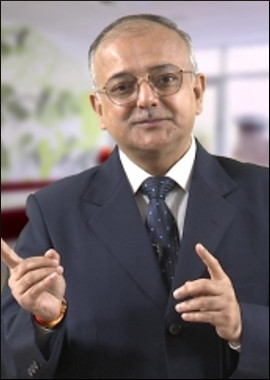
compels us to think that life is the most valuable thing," says Vinay
Sharma, a Professor in the Department of Management Studies at
IIT-Roorkee, the lead author of "Stop Predicting Revisit Life, Lessons
from Covid-19" (Bloomsbury).
India and Indians "have fought
exceptionally well and we have realized the value of life more than
ever. During this war against Covid-19, we have realized the importance
of being together, fighting together and caring for each other", Sharma
told IANS in an interview.
We have realised the value of doctors,
medical practitioners, all kinds of forces; people who are leading the
economy; people who are contributing in the economy; skilled workers in
the field of medical sciences; support teams; farmers, people
contributing in transporting goods; media personnel, in fact, everyone
who has contributed even a little bit in this war, he elaborated.
"More
than ever, we have realized the value of leadership at all the levels
and the icons who can motivate us, and make us believe that this would
pass. Many people have lost their dear ones and those imprints would
remain for a long time. Many had to struggle in different ways, but
believing in ourselves and in each other and believing in processes
related to living a happy and a healthy life is what we believe now,"
Sharma maintained.
How has Covid-19 changed our philosophy of life and our understanding of the future?
"Don't
go too far, try to find contentment. Do care for others, do care for
nature, care for the environment, believe in the community, believe in
society, live for your country. All the fundamentals have
re-strengthened themselves. This is evident as people have started
choosing the methods and the ways related to the fundamentals of life
and values. But we must learn to be more civic," Sharma said.
Does India need a new comprehensive law to combat a Covid-19 like pandemic in future from the lessons learned?
"In
the wake of the serious governance challenges that India faced, the
Covid-19 crisis has highlighted the urgent need for a legislative
framework in the form of a new national law to combat such a pandemic in
future. The legislation should include a legal framework to set up a
national crisis communication protocol and a new framework for health
governance," he said.
The absence of a viable national crisis
communication protocol aggravated the Covid-19 crisis, especially during
the first two waves and has necessitated the need for such a policy at
the district, state and national levels to deal with such public health
disasters in future, Sharma maintained.
"Also, the pandemic has
exposed the weaknesses in the existing public health communication
systems and highlighted the urgent need to restructure and reform them
to meet the challenge posed by such public health disasters in future.
Such a policy response would help strengthen the existing public health
communication systems," he elaborated.
What new measures are needed to augment healthcare facilities, especially in small towns and villages?
"General
awareness about health and healthcare, in terms of keeping oneself
healthy and to equip people for helping others in cases of situations
wherein the participation of large numbers of people is required has to
be the first step.
"Inter-connectivity of people with systems and
systems with people in terms of provision of healthcare has to be
strengthened, as have ambulatory services and a healthcare-related
skilled workforce. Most of all, doctors and nursing staff have to be
larger in larger numbers, not only looking at the required perspective,
but also looking at the numbers that should exist for a large
population," Sharma explained.
The biggest lessons learned from such kinds of situations are to be cautious, to nurture, and to value life.
"Contentment
is the key. We must remember our duties. We must remember that our
objectives should primarily be to serve our nation, society, elders, and
the community, while imbibing healthy living, and by being consistent
throughout lives, while caring for the nature, not wasting resources,
and not generating waste," Sharma concluded.
The other co-authors
of the book are Rabindranath Bhattacharyya, a Professor of Political
Science at the University of Burdwan; Sanjeev Kumar Mahajan, a Professor
of Public Administration at Himachal Pradesh University, Shimla; and
Himanshu Shekhar Mishra, a Senior Editor with NDTV India.
(Vishnu Makhijani can be reached at vishnu.makhijani@ians.in)
|
|
|
| |
|
|
|
|
|
|
|
|
|
|
|
|
|
|
| |
| Customs Exchange Rates |
| Currency |
Import |
Export |
US Dollar
|
₹96.5
|
₹94.8 |
UK Pound
|
₹132.25
|
₹128.15 |
Euro
|
₹113.6
|
₹109.8 |
| Japanese
Yen |
₹61.3 |
₹59.45 |
| As on 03 Sep, 2026 |
|
|
| Daily Poll |
 |
 |
| What’s your biggest challenge with the 45-day payment rule? |
|
|
|
|
|
| Commented Stories |
|
|
|
|
|
|
| |
|